A Conversation With Penfolds Chief Winemaker Peter Gago
In this interview, Penfolds’ Chief Winemaker Peter Gago talks about two things in particular: how a house founded in 1844 keeps its stylistic DNA intact across generations of winemakers, and the story behind Grange, from Max Schubert’s “hidden” vintages to the new Grange La Chapelle collaboration

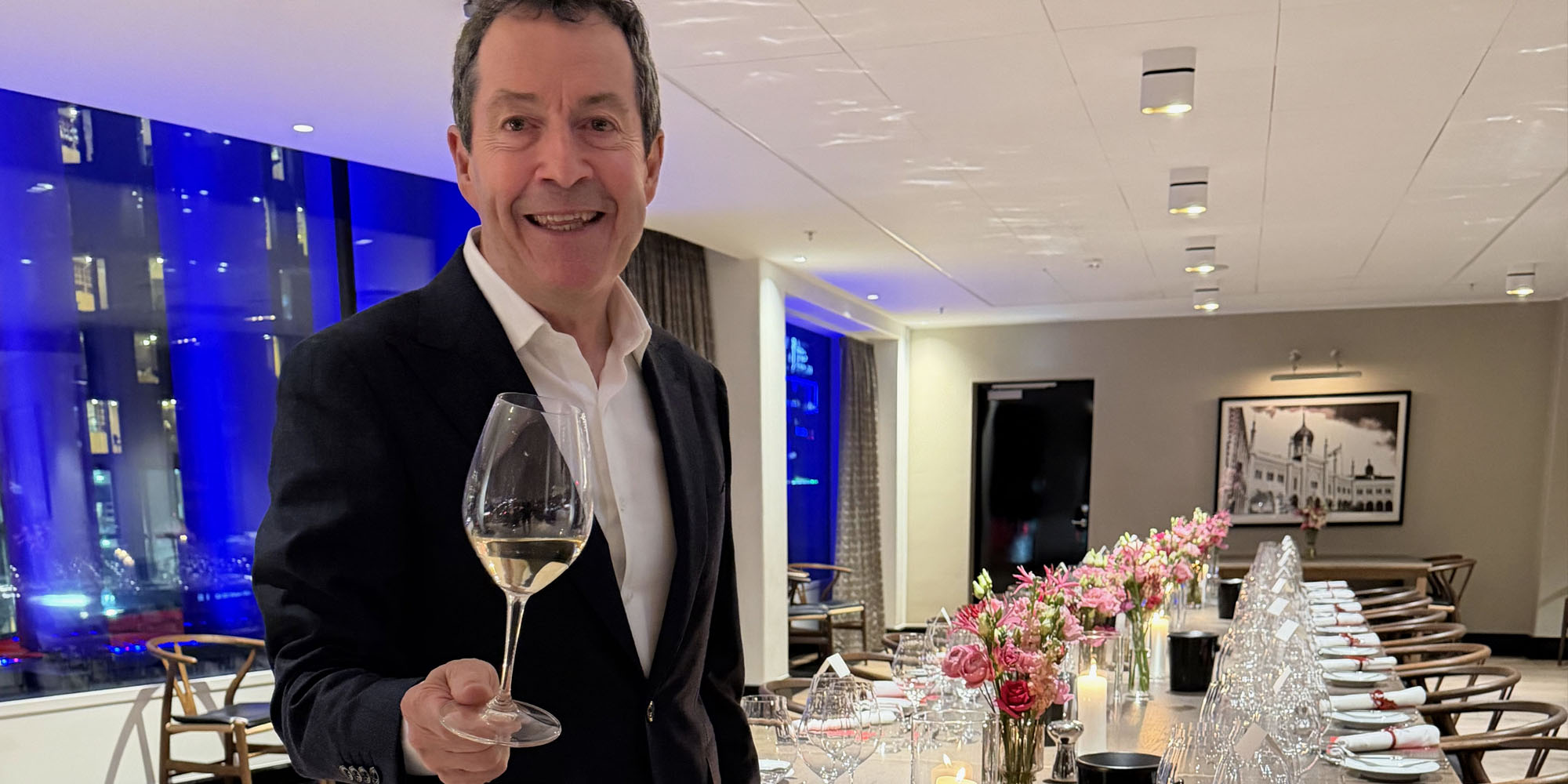
On 10 November, Winest hosted a winemaker’s dinner at Nimb Hotel in Copenhagen together with Penfolds and its Chief Winemaker, Peter Gago. Over a four-course menu, Peter presented each of the evening’s wines himself, from Penfolds’ champagne and Yattarna Chardonnay to St. Henri, Grange 2010 and 2021 and the fortified tawnies, with Grange La Chapelle served as a surprise. Visits to Denmark by Peter are rare, so shortly before the guests arrived, we used the opportunity to sit down with him for a small conversation.
In this interview, Penfolds’ Chief Winemaker Peter Gago talks about two things in particular: how a house founded in 1844 keeps its stylistic DNA intact across generations of winemakers, and the story behind Grange, from Max Schubert’s “hidden” vintages to the new Grange La Chapelle collaboration.
The interview opens with the big question: what has made Grange such a success in the world?
Peter Gago starts with the calendar. 2026 marks the 75th anniversary of Grange, which means 75 consecutive harvests without a single missed vintage. He contrasts this with Penfolds’ flagship Cabernet Sauvignon, Bin 707, which has skipped several years. The explanation, he says, is simple: Shiraz is ideally suited to the climate of South Australia. It ripens reliably and is often picked and in barrel while Cabernet is still waiting in the vineyard, exposed to rain or, these days, smoke.
Beyond the grape, he points to the way Penfolds sees itself. When asked what he wants Penfolds to be, his answer is “the world’s biggest boutique winery”. Because the market perceives Penfolds as big, the house has always felt it had to over-deliver. A Bin 389 cannot simply be a Cabernet-Shiraz at a given price; it has to offer something more.
He also highlights the role of collectors:
• Many long-standing Grange owners bought their bottles when the wine was far more affordable, and some of those bottles are still developing in their cellars.
• Penfolds offers what he calls “the lovely C-word”: choice. The wines can be enjoyed young or cellared for secondary and tertiary characters, even at entry level.
• Penfolds publishes drinking windows across its entire range, not just Grange, which in his view builds trust and confidence in the brand over time.
How do you maintain quality when people and teams change over the decades?
Gago calls himself “a youngster” at Penfolds, despite 38 years with the house and almost 25 years as Chief Winemaker. In all that time, Penfolds has had only four chief winemakers: Max Schubert, Don Ditter, John Duval and Gago himself.
The continuity, he explains, lies in the winemaking team and in the way people are brought in. There are two routes into the team: through the cellar or laboratory, or through a degree in oenology. Either way, he says, you only really learn to make Penfolds wine once you are inside. He prefers to describe Penfolds as a culture rather than a brand, and he borrows a term from Champagne: house style.
When he took over the role, the wine media asked what he planned to do with Grange. His answer was two words: “absolutely nothing”. The style is set. The ambition is to make a better Grange than the legendary 1952, 1953 and 1955 vintages, but by refining and tweaking, and with ego left out of it.
He points to how long Penfolds’ styles have remained unchanged:
• St. Henri: same style since 1888
• Grange: since 1951
• Bin 28: since 1959
• Bin 389: since 1960
• Bin 128: since 1962
• Newer additions such as Bin 407 (1990) and Bin 169 (2008)
His comparison is the New York Times masthead, which he notes has not changed since the American Civil War, because it doesn’t need to. Most of his job, he says, is making sure that Bin 389 always looks like Bin 389, yet no two vintages are the same.
From chemistry teacher to chief winemaker
Before wine, Gago taught chemistry and mathematics for three and a half years before returning to university to study oenology. When he chose Penfolds, friends questioned why he would join a large company rather than a family estate or one of the new boutique producers. He says he has never regretted it.
He describes the order of his relationship with wine as wine lover first, collector second, winemaker third. The skills from teaching (communication, discipline, planning) are ones he still uses. Alongside Penfolds, he serves as an ambassador for the Great Wine Capitals network through the Bordeaux Chamber of Commerce.
How do you keep pushing forward with energy and innovation?
According to Gago, the key is that the winemakers are allowed to make the call on most winemaking decisions. “Not everything. It’s not fairyland,” he adds. Many of Penfolds’ newer projects did not come from focus groups but from winemaking curiosity or from friendships:
• the G3, G4 and G5 wines
• the Penfolds Ampoule project, launched in 2012
• the champagne collaboration with the House of Thiénot, Penfolds’ former agents in France
• Grange La Chapelle, which grew out of a friendship with Caroline Frey of Paul Jaboulet Aîné
Today Penfolds makes wine in France,California and China as well as Australia. Gago is clear, however, that South Australia remains the “nerve centre” and spiritual home, and that the other projects are satellites built on the same principles and the same post-harvest classification tastings.
What is the philosophy that linksthe entry-level wines to the top wines?
House style, Gago stresses, does not mean formula. Mother Nature throws curveballs every year. South Australia is the driest state on the driest continent, yet its winter-dominant rainfall suits grape growing, and many vines in the region are more than a century old.
He rejects the idea that blending is somehow “cheating”. In his view, blending is the art of winemaking, and you only blend if the result is better than its parts. Penfolds works with four broad approaches:
1. Single-vineyard wines that express a sense of place
2. Single-region blends that show what a region does best, such as Bin 128 and Bin 169 from Coonawarra
3. Multi-regional South Australian blends
4. Multi-country wines
Flexibility is essential. In a warm year Penfolds may source from cooler regions in the south; in a cold year from warmer areas further north, such as Clare and the Barossa. Gago notes that Australia has some of the strictest label integrity laws in the world, but that there is considerable flexibility right up until the blend is assembled.
Penfolds is best known for red wine ...But how important are the whites?
“Hugely,” he answers, and they will become more important as tastes evolve. He sees strong interest in Riesling, Chardonnay and other white varieties.
The history goes back further than many expect. In his office at Magill Estate stands a silver trophy awarded in 1890 for white wine, inscribed not to Penfolds but to Mary Penfold, the founder’s wife. The word “Chardonnay” did not appear on Australian labels until 1971.
When Penfolds launched its champagne, the 2012 vintage, in Paris, Gago brought along a Penfolds wine from 1912, to show that the venture into sparkling wine was not, as he puts it, “a wave of a magic wand”.
Do you have a favourite story about Max Schubert and the creation of Grange?
The best-known story, Gago says, is that of the three “hidden” Granges: 1957, 1958 and 1959.
In the early 1950s, Grange was misunderstood. Most Australian reds at the time were matured in large old vats, and this new wine, made from low-yielding fruit and aged in 100% new oak, was very different. The family that owned Penfolds ordered Schubert to stop production. Gago’s own theory is that Schubert, in his enthusiasm, simply showed the wine to people too early.
Schubert carried on in secret, under threat of instant dismissal, hiding bottles and barrels in the underground cellars. What he could not hide was invoices for new oak. As a result, the 1957, 1958 and 1959 are the only Granges not matured in new oak: they were aged in one-, two- and three-year-old barrels respectively.
The turning point, Gago explains, came at the 1962 Sydney Wine Show, where the 1955 Grange swept the field. When the family pointed out that Grange had been discontinued, Schubert could reveal what he had been making all along.
What makes Grange stand out amongthe world’s great wines?
For Gago, the point of difference is everything: “There’s nothing else really like it.”
He acknowledges the criticism of 100-point scores, but notes that scores have helped benchmark Grange against the world’s great wines, showing that very different wines can sit at a similar quality level. He mentions the 1990 Grange, named Wine Spectator’s red wine of the year in 1995, as a milestone that gave Grange a new level of recognition. He also describes recently pouring the 1990 Grange alongside the 1990 La Chapelle at an event in London.
Even within Penfolds, he says, not everyone’s favourite Shiraz is Grange; for some it is RWT or St Henri. That is why the house makes several Shiraz styles. Ultimately, he says, the market decides how these wines are received.
The recent prestige-project including Grange is done in collaboration with La Chapelle, but why La Chapelle? Penfolds could have chosen any Syrah-winemaker to partner with.
The project started almost by chance at the beginning of the COVID-19 pandemic. Gago sent Caroline Frey a series of unlabelled South Australian Shiraz samples, including a Barossa Shiraz, a large-oak-matured blend and a new-oak-matured blend, without telling her which wines they were (RWT, St Henri and Grange). She did the same with wines from the northern Rhône. They tasted and blended blind, at first virtually.
One combination stood out: Grange and La Chapelle. The first blend was roughly 48/52. When a 50/50 version proved indistinguishable, they settled on an equal split, which Gago describes as the right choice “politically, pragmatically” and for the story.
The principle is strict: if one side has a weak vintage and the wine cannot hold up as a 50/50 blend, it is not released that year. Like a vintage port declaration, each vintage must be declared. Gago explains that the 2023 and 2024 vintages are currently being assessed, and that a release can only be “there or above” the level already set.
Finally: one wine experience that stands out above all others?
Gago picks a vertical tasting of Château Latour in Bordeaux, which he attended years ago after receiving a last-minute invitation from director general Frédéric Engerer. The wines went back to 1878, with the great 1928, 1945, 1961 and 1982 vintages along the way. The 1878, he notes, held for 21 minutes in the glass before fading.
He thought he knew some of these wines, including the 1982, which he once bought himself. That night, he says, he realised: “I’ve had this before, but I’ve never had this.”
It was not one single wine that made the evening, but the experience as a whole. It finished in the early hours, and he never once looked at his watch. “It was just unbelievable, magical.”
The conversation with Peter Gago shows a house that treats consistency as its core discipline: fixed stylistic templates, a small line of chief winemakers, and the deliberate absence of ego. At the same time, Penfolds continues to move into new regions, new countries and new partnerships, from Champagne to the Rhône. Like many fine wine producers, Penfolds holds both at once: a style that stays the same and a range that keeps changing.
Få de seneste opdateringer om Winest og vininvestering!