Interview with Jean-Guillaume Prats
The conversation takes place between Jean-Guillaume Prats and Steffen from Winest and covers two main themes – Bordeaux as a wine region and JGP's personal journey there, and Bordeaux’s impact on the wider world of wine and vice versa

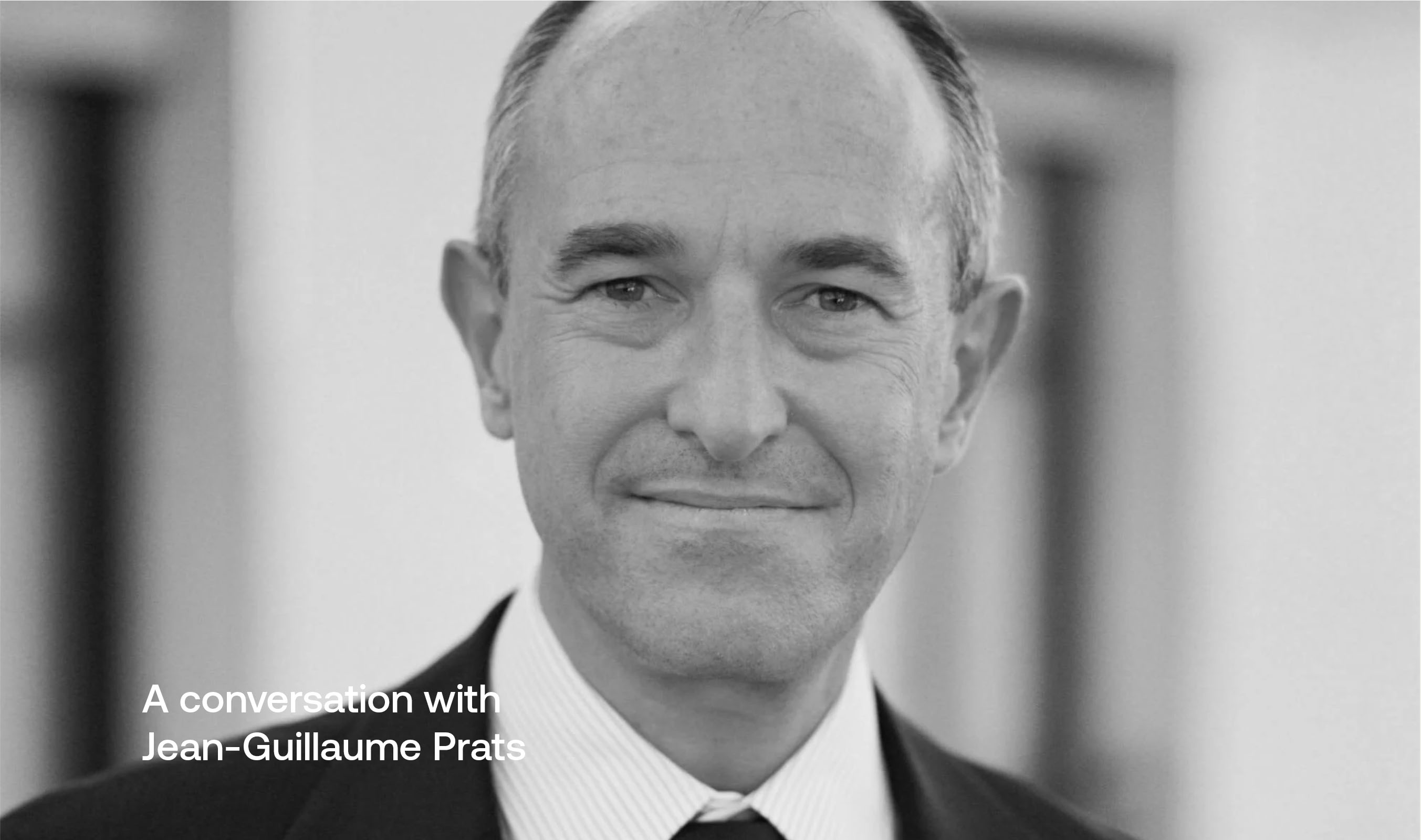
The interview begins with a broad framing: the conversation will cover two main themes – Bordeaux as a region and Jean-Guillaume Prats’ personal journey there, and Bordeaux’s impact on the wider world of wine.
When asked to highlight the biggest milestones in his development as a wine professional in Bordeaux – what has shaped him most and what he is proudest to have been part of – Jean-Guillaume Prats immediately points to a turning point around the year 2000. With the opening of the Chinese market, demand for Bordeaux surged, ushering in an exceptional period of prosperity for the region.
Crucially, this prosperity was not only enjoyed, but reinvested back into Bordeaux
- into vineyard practices and management,
- into new winemaking equipment,
- into research and technology, and
- into the education and training of technical teams.
He stresses that this combination of research, science, education, viticulture and high-quality investment in cellars and winemaking methods is what has defined modern Bordeaux. In his view, no other wine region in the world has seen this level of prosperity and reinvestment on such a scale. If he has to identify a single milestone, it is this post-2000 phase of growth driven by China and the way Bordeaux chose to reinvest it.
-----------------
When the interviewer shifts to internal factors – what within Bordeaux itself, beyond external demand like China, has driven improvement – Jean-Guillaume Prats highlights the importance of the “vin de garage” movement on the Right Bank in the late 1980s and early 1990s.
He believes history will eventually recognize that this movement, led by figures such as Hubert Dubois and the owners of Château Valandraud, played a fundamental role. The “vin de garage” approach demonstrated that:
- meticulous attention to the vineyard,
- low yields,
- precise canopy management,
- very ripe, concentrated fruit, and
- extremely detailed winemaking
could elevate a wine to the highest levels of quality and consumer recognition, even from relatively modest origins.
When he joined Cos d’Estournel in 1995–1996, he went with his team to visit these “garage” producers. His team’s first reaction was that the methods were excessive. His own instinct, however, was to ask: what if we adapt some of these techniques and ways of thinking to the extraordinary gravel terroirs of the Left Bank, to old CabernetSauvignon vines?
He sees this as a pivotal internal trigger: the vinde garage movement shook the tree and forced the great Left Bank estates to raise their technical standards, integrating some of these intensive, quality-driven practices into grand cru terroirs.
-----------------
The interviewer then asks how Bordeaux’s culture and history have shaped his approach to winemaking and to managing prestigious estates: what influences have shaped the way he works?
Jean-Guillaume Prats explains that his decision-making has always tried to balance innovation with tradition. On one side, there is innovation, forward thinking and sometimes disruptive ideas– an influence that clearly traces back to the vin de garage spirit and other avant-garde concepts. A concrete example is the new gravity-flow cellar builtin 2008, which he notes was the first of its kind in Bordeaux.
On the other side, there is respect for tradition and the lessons of the past – the need not to turn the key too quickly toward any new fashion that may appear to be a solution today but might not stand the test of time. Bordeaux, he says, is very good at
- preserving tradition and know-how,
- remembering past mistakes and learning from them, and
- adapting to new challenges and changing consumer tastes.
This duality – innovation anchored in tradition – is central both to Bordeaux and to his own philosophy.
------------------
The conversation then zooms in on what he personally has changed or driven, both in large and small ways, and whatJean-Guillaume Prats is most proud of having implemented in Bordeaux and the wider wine business.
He cites two main achievements
- Creating the white Cos d’Estournel
He is proud of having created what is now recognized as one of Bordeaux’s greatest white wines. For him, this is proof that you can begin with a blank sheet of paper and a long-term vision and, over 10–20 years, build something genuinely meaningful – even in a region where many benchmarks are more than a century old. It’s a powerful example of entrepreneurship in a landscape dominated by old estates. - Mentoring and moving people forward
The second source of pride is the people and teams he has worked with over his career – especially younger professionals he has helped move into new roles, responsibilities and regions. He mentions the example discussed the previous evening: the CEO of Cloudy Bay is a Chinese gentleman, originally from Chengdu in Sichuan, who has been in that role for six to eight years. Jean-Guillaume Prats finds it extraordinary that someone from Chengdu now leads one of the great New World icons and sees this as a powerful message to Chinese consumers and wine professionals worldwide: it is possible to dream and succeed in the wine world, no matter where you come from.
-----------------
Asked why, at this stage of his career, he has chosen to invest so much energy, love and innovation in Provence, he insists there is never just one reason – it’s always a mixture of timing, circumstances and encounters.
First, there were his partners, Stéphane Corby, Carla Bruni and former President Nicolas Sarkozy. The opportunity arose to do something together, and, as he says, nothing important is ever done alone.
Second, and more structurally, is the unique moment Provence is experiencing. Today, in the world of fine wine, Provence has become the main focus of attention:
- foreign investment is flowing in,
- new ideas and disruptive label concepts are emerging, and
- ambitious projects are being launched.
Twenty to twenty-five years ago, this energy was in California, then in Chile, Australia, South Africa or parts of Italy. Now, he says, it is in Provence, and as a Frenchman he feels privileged that this new epicenter is in France.
At the same time, Provence is not being built from nothing. Behind the new labels and modern concepts stand generations of local families who have been farming vineyards for decades, knowing exactly which rootstocks, clones and varieties to plant, and how to manage each parcel.The role of people like him is to bring modernity and innovative ideas to this deep reservoir of experience.
He acknowledges that in ten years the global focus might shift again – perhaps to Sicily or Portugal – but right now the fine-wine frontier is Provence, and that is why Jean-Guillaume Prats jumped into the adventure.
------------------
Returning to Bordeaux, the interviewer asks about the classic tension between tradition and innovation, and how he sees the balance in Bordeaux today and his own view of Bordeaux’s role as a wine region.
From the outside, he admits, Bordeaux can appear old, slow-moving, traditional, even arrogant. But that is only half the truth. The other half is that Bordeaux has an extraordinary capacity to readjust and adapt to circumstances. Historically, the region has repeatedly faced and survived crises:
- phylloxera,
- the war of 1870,
- World War I and World War II,
- the economic crises of the 1950s and 60s,
- the oil crisis of the 1970s,
- the crises of the 1980s and 1992,
- the 2008 financial crisis, and
- the current consumer-driven downturn.
Each time, Bordeaux has come out of crisis faster and more innovatively than other regions. That is the dual culture of Bordeaux: deeply traditional and established, yet remarkably quick to move, reinvent and bounce back.
---------------------
The interviewer then broadens the perspective to Bordeaux’s role in the global wine world today compared to 10–20 years ago, and how that relates to innovation.
Jean-Guillaume Prats notes that over the last 30–40 years, Bordeaux has contributed to the worldwide wine industry not just by producing wine, but by exporting its skills, concepts and capital.Bordeaux producers have invested in California, Chile, Spain, New Zealand,South Africa and beyond, much as the Champenois have done with projects like Chandon in Brazil, California and Argentina. Bordeaux has been very good at taking its know-how, innovation and financial resources abroad.
Now, however, many other regions have learned todo the same. The key question becomes: what will Bordeaux bring to the future?
He sees two main assets for consumers
- Quality – the high quality of the wines themselves is the obvious and traditional strength.
- Volume of high-quality wines – Bordeaux can produce significant quantities of high-quality wine, distributed across the world, at many different price points. This makes Bordeaux relatively easy to find and buy, whether at an entry level or at the top.
Looking to the future, he believes Bordeaux must offer more than quality and availability. It should offer a new message to consumers: a message of authenticity, craftsmanship and simplicity. Ideally, when someone buys and opens a bottle of Bordeaux, they should feel themselves stepping into a bubble of serenity – a small moment of pleasure, harmony and calm in an increasingly turbulent world.
That, he says, is the real challenge forBordeaux: to link its wines with this emotional and experiential promise.
--------------------
Asked how climate change, shifting consumer preferences and technological innovation will shape the future of Bordeaux and whether they will drive further change, he emphasizes something he considers fundamental: university and scientific research.
In his opinion, the University of Bordeaux is today the leading global center for wine research in areas such as:
- vineyard practices,
- enology,
- sustainable development,
- organic viticulture,
- long-term sustainable farming strategies, and
- broader wine-industry management.
This position, he explains, is partly due to the prosperity that has been reinvested in research, and partly due to Bordeaux’s long-standing academic and scientific tradition.
He is convinced that Bordeaux will play a major role in addressing the challenges of:
- global warming,
- low- or zero-alcohol products,
- reducing farming costs,
- the growing difficulty of finding labor for the vineyards, and
- the increasing use of mechanization and artificial intelligence.
He notes that many of the improvements and new ideas in these fields will likely emerge from Bordeaux simply because it is such a strong research hub.
Jean-Guillaume Prats underscores this point with a personal observation: in all his many trips to China, almost every young wine professional he met there had been trained in Bordeaux – not in Adelaide, Davis, Stellenbosch or even primarily Montpellier or Dijon. This reflects the extraordinary attractiveness and influence of Bordeaux’s academic institutions, which he sees as a major competitive advantage for the region.
The interviewer comments that this also means many outsiders bring their own perspectives into Bordeaux and feed back into the region. He agrees and describes Bordeaux as a melting point – a place where international students, ideas and experiences converge.
-------------------------
From there, the interviewer asks whether foundational aspects of production such as grape varieties should also be a field for experimentation in Bordeaux, given climate change and evolving conditions. Should Bordeaux welcome new varieties into its traditional mix of Merlot, Cabernet Sauvignon and others?
He is careful to say he is not a scientist and that experts at the University of Bordeaux are far more qualified, but he does share his view. First, he highlights what he sees as a clever move by the Médoc appellation authorities: allowing white wines produced in the Médoc to be labeled as Médoc rather than just generic Bordeaux. There are already some very good whites being produced there, and this decision, in his view, upgrades the whole category.
Regarding red grapes, he believes climate change may make some Portuguese varieties particularly interesting additions for Bordeaux, mentioning Touriga Nacional and a couple of others that are already being discussed. He knows this is not just theoretical: there is active thinking and some moves already being made in that direction. Again, he connects this back to his earlier point: Bordeaux is quick to think ahead and to react, even on something as traditional as grape varieties.
---------------------
When asked what the New World has brought to Bordeaux, given that Bordeaux has clearly influenced the rest of the wine world, he identifies two major contributions
- Water and irrigation management
The New World – and especially experts from Israel – has led the way in understanding irrigation, water management and how to handle vineyards under stress. Many of the world’s best specialists in irrigation come from Israel, and these techniques and insights have been imported back into Bordeaux and integrated into viticulture there. - The “blank sheet of paper” project model The New World, and in particular Napa Valley, has shown the world that you can start with nothing but an idea and a long-term plan, and build a world-class wine project in a relatively short period. He cites the Harlan familyas a prime example: they created Harlan Estate, Bond and Promontory essentially from scratch some 20–25 years ago, and today these are among the world’s most coveted wine labels.
From this, Bordeaux has learned that it is possible to conceive and execute a great project entirely anew, rather than relying solely on centuries-old estates.
---------------------
To end on a lighter note, the interviewer asks which single bottle from his time in Bordeaux Jean-Guillaume Prats would take to a desert island, and why.
He chooses Cos d’Estournel 1870. He has had it on a few occasions, and he tells a vivid story of one of those moments inLondon at Berry Bros. & Rudd. The BBC was filming a documentary about the merchant over the course of a year, and he was one of the wine professionals featured. The closing scene was a dinner at Berry Bros.
They were all drinking great wines when two decanters of the same wine were brought to the table, which was shared only by top UK wine collectors. No one knew what the wine was. As people offered their guesses, they suggested things such as Pétrus 1982, Château Latour 1989 and Lafite 1959.
When his turn came, he initially had in mind a wine from the 1800s, but he felt that would sound foolish because the wine in the glass was so fresh and powerful. So he toned it down and said he thought it was from the northern Médoc, either Château Lafite or Cos d’Estournel 1928, knowing that 1928 wines can be very spicy and almost curry-like.
In the end, the wine turned out to be Cos d’Estournel 1870, and his guess was the closest – just 50 years off, whereas others were off by more than a century. He has since had the 1870 Cos d’Estournel on another occasion, at a farewell dinner organized by Baron Eric de Rothschild and Saskia de Rothschild when he left Château Lafite. They opened a bottle of Cos d’Estournel 1870 from the Lafite cellars to share with Bordeaux friends.
He concludes that this wine is not just extraordinarily old and still alive; it is also a bridge through time, which is why he would choose it for a desert island.
-----------------------
The interviewer then asks a related “silly”question: how old can a wine really get?
Jean-Guillaume Prats replies that wines can age almostindefinitely if certain structural conditions are present:
- very high acidity, as in Madeira, can allow a wine to age “forever”;
- strong tannic structure, as in great Cabernet-based Bordeaux or certain vintage Ports, can also support extremely long aging.
He confirms that the 1870 Cos d’Estournel can still be drunk with pleasure today – though you must drink it fairly quickly, as it fades in the glass after about an hour. The magic lies in that brief period when you feel you are travelling through time.
-------------------------
Finally, the interviewer asks for a moment in Bordeaux that made him think: “this could only happen in Bordeaux”.Rather than picking a memory from the past, he gives a forward-looking answer.
He hopes that this defining moment is still ahead, perhaps during the next en primeur campaign in May–June. The current fine-wine market is in turmoil, and Bordeaux is facing difficulties – not because of quality or style, but because of a lack of demand.
Jean-Guillaume Prats hopes that Bordeaux will once again demonstrate its unique capacity to react by:
- being very precise and disciplined in how it positions the 2025 en primeur wines,
- getting pricing, timing and messaging exactly right, and
- rekindling the passion of consumers around the world.
For him, a truly “only in Bordeaux” moment would be seeing the entire Bordeaux trade align and execute this with clarity and unity, restoring Bordeaux to its former momentum.
In response to a follow-up question about whether the Place de Bordeaux and the en primeur system remain one of the key backbones for getting Bordeaux wines to the world and driving interest, he answers firmly yes.
En primeur is:
- a yearly moment when global attention is focused on Bordeaux,
- a tradition that has existed for decades and creates a special momentum, and
- an opportunity to send a clear message that Bordeaux has endured crises but is also entering a new phase of excitement.
He underlines that the Bordeaux system of courtiers and négociants is unique, highly reactive and extremely efficient. It is something that should be maintained and kept as strong as possible, as it is central to how Bordeaux reaches the world.
The interview ends there, with a portrait of Jean-Guillaume Prats and Bordeaux as a story of continuous negotiation between tradition and innovation, local roots and global influence, past heritage and future challenges, always looking ahead while remaining anchored in what makes the region unique.
Få de seneste opdateringer om Winest og vininvestering!