"Nothing Feels Like Work" - A conversation with Cees van Casteren MW
The conversation takes place between Cees van Casteren and Steffen from Winest and covers passion, Master of Wine-education and the art of staying open...

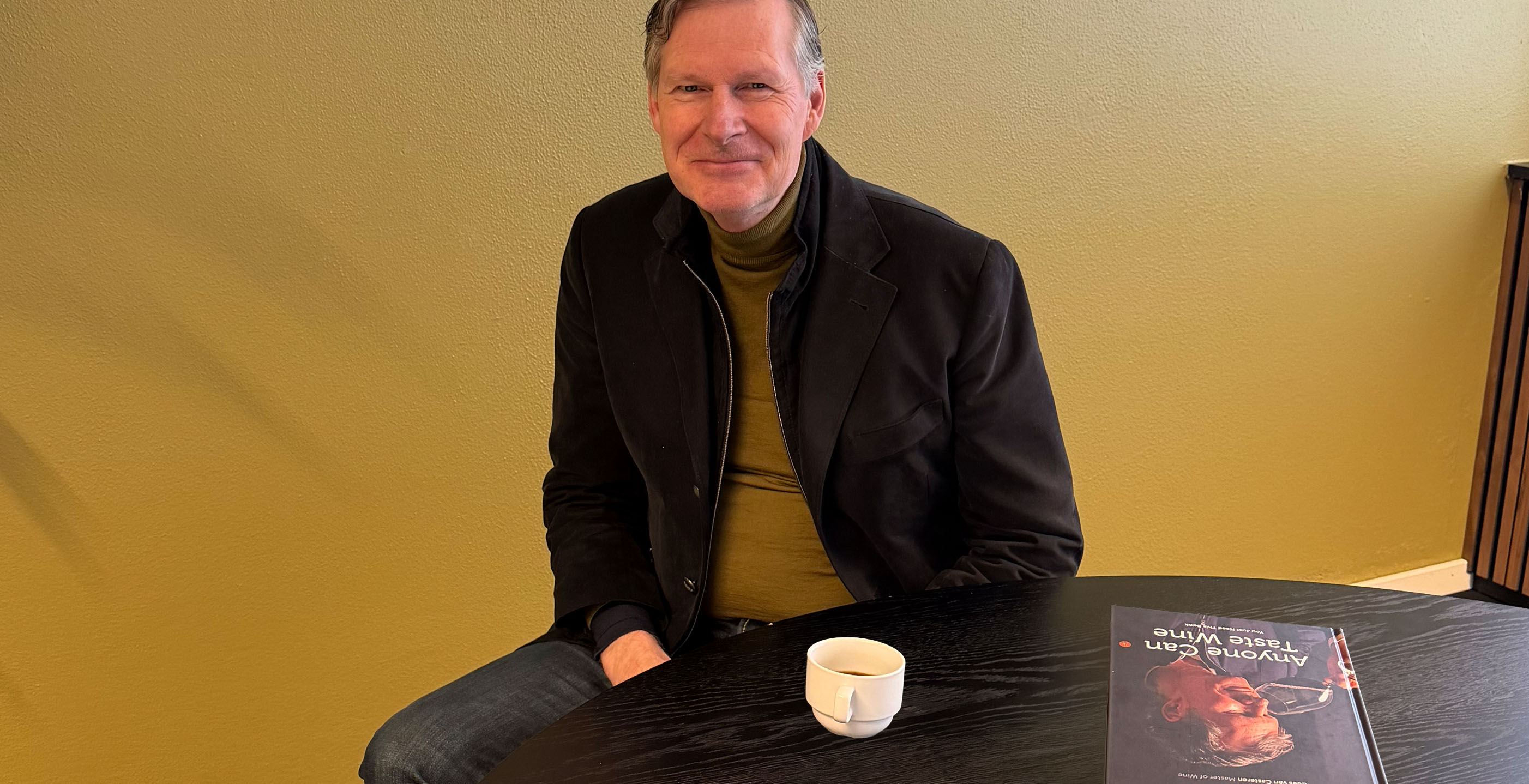
The interview begins with a broad framing and dives in to detailed topics on Cees´s entry to- and life with wine...
Let's start broadly. Can you tell us a little about your background — how you first became interested in wine, and how it became more than just an interest?
Like many people, I drank beer as a student; I was actually a proud member of a beer society with the slogan"everyday elite." Wine didn't come into the picture until my first job in the chemical industry, and even then, it started as nothing more than a love of the drink and a curiosity to learn more. No courses, no structure - just sitting with friends, buying bottles, and talking about them.
Then the company I worked for sent me to the US as an area sales manager. I got promoted and moved in new and different circles in New York City and eventually met a man named Michael Aaron, CEO of Sherry-Lehmann, which at the time was the premier fine wine supplier in New York. We got in to talking about wine, and after an hour he said, "If you're ever interested in a career in the wine trade, give me a call." I was happy where I was, but I thought: this is the American way of finding a new job. I got interested so after a while, I called...
We had lunch at the Four Seasons. Michael told me the wine trade was quite conservative, and it didn't attract university graduates. Those who rose to the top in the wine business did so through experience alone. He wanted to help me with that as he felt I had the heart for wine. He offered me a place on his management team, with one condition: I needed experience, which I had none of. His solution was study (Master of Wine). He would sponsor me so I could do it in my own time, and once I passed, I'd walk straight into his team - no questions asked.
So, I thought I'd rather sell Burgundy and Champagne than hydroxide and sulphate. I agreed and he told me about the Institute of Masters of Wine which I had never heard of. It turned out that getting accepted wasn't easy, you had to apply, sit a small exam, write an essay, show references, prove experience. After my first attempt I received an extremely polite letter, only the British can do it this way :) declining my application, noting that I would "benefit more from the programme with 10 to 15 years of experience." A very polite way of saying: you are not suitable.
That was 1992 and my first try didn't work out, and I stayed in my job. But Michael had planted a seed so when I returned to Holland in 1996, I did every wine course I could find outside of the MW programme. I then discovered that the parent company I worked for had acquired a business called Gist, the Dutch word for yeast, which had an oenological division in the south of France. I applied and got the job. Now I was officially in the wine business: supplying yeast, enzymes, bacteria, and 150 other products including sulphur dioxide and acids. I then re-applied to the Institute of Masters of Wine. They probably thought, "We'll never get rid of this man," :) and they accepted me. That was my conversion — from hobby and interest to: this is my future. This is my passion. This has to be my job.
It sounds like passion was always the driver. But how did you balance that with the ambition to enter the industry at a high level, rather than just following the wine?
It was all passion — I didn't realise quite how passionate I was until Michael Aaron presented me with an idea and a future. The ambition and the passion were the same thing and once I got into wine, nothing felt like work. It doesn't feel like work now …It feels like doing something I genuinely love, and getting paid for it.
Looking at your Master of Wine journey —what was the toughest challenge? Theory, tasting, maintaining focus throughout the course?
What struck me early on was a paradox. The British wine trade and the Dutch wine trade are very similar —both free open markets where anyone can import and sell directly to private individuals. Similar wine markets and similar general knowledge about wine, yet the British students had a pass rate, when applying to MW, of around 20 to 25 percent, while in Holland, out of perhaps 50 attempts, only one person had passed. We are no less intelligent. We have a similar trade. Why the difference?
I passed the tasting component early, that was the most enjoyable and "easy" part for me. But I struggled with theory, even though I was certain my knowledge was on a par with my British counterparts.
With just two months left before my final attempt, because the number of attempts is limited, I got a call from a woman named Heather. Her brother-in-law was a winemaker in the Elgin Valley whom I had visited years earlier and written about in Holland's leading wine magazine. An importer had found him because of that article and begun representing his wines. But he had since developed cancer and could no longer attend to his clients. He therefore asked Heather to step in, though she had no wine knowledge at all, and he suggested she contact me for a few days of training.
I told Heather I could help, but that I needed a budget. We arranged our first session and over a lunch I asked what she did professionally. She said: "I'm a professor of essay-writing skills at the University of Amsterdam." And in that moment, I suddenly understood everything...
My weakness at the MW was not knowledge. It was format. The British essay format is a specific art and paramount to master to succeed in the Master of Wine education. It is simply not part of the Dutch educational system. I told Heather I wasn't going to send her an invoice. Instead I was going to send her an essay for her to review and comment on. I started sending her my essays and after receiving my first essay-draft she called me and said: "You would never have passed, this is not an essay! This is an attempt to persuade the examiner that you know a great deal …but it won't pass." For two months, I wrote an essay almost every day, and she coached me. Only then did I pass MW. It was five to twelve when I met her - but without her, I would have failed to pass my exam.
And that's essentially why so few Dutch candidates have passed the MW?
Exactly. Knowledge is not enough. It's how you convey that knowledge. Essay writing is not taught in the Dutch educational system, and the MW is examined in a very particular British academic format. That gap has cost many talented people their chance.
This journey and education has clearly shaped everything that followed — including your book "Anyone Can Taste Wine." Why did you feel there was a need for that book, and what approach does it take?
Many people are genuinely interested in wine tasting, but they find it mystical. They'll say: "I know what I like, but I don't know much about wine." They don't know how to approach tasting in a structured way. Even with WSET or similar qualifications, there are so many factors to consider that it becomes hard to hold it all together.
When I was working towards the MW, I wanted something simple to follow, a logical sequence that moved from sight to smell to palate. So, I developed an acronym, CHARACTER, where each letter stands for a specific element. The idea is that you simply note the intensity of each one: colour, aromas, winemaking style, whatever it may be, and record your observations in a structured way.
The book tries to make wine tasting genuinely accessible. It's easy to make something complicated; it's much harder to make something simple. Between the Dutch and English editions, we've now sold close to 30,000 copies which tells me the approach connects with people, many of whom are not wine professionals, just genuinely curious.
That's essentially about bringing tasting down from the mystical to the accessible. But let me challenge that slightly. A recent piece in The World of Fine Wine asked whether wine knowledge enhances the experience — or whether it simply becomes a fault-finding distraction. The suggestion was that the best way to develop your palate is to step back from structure and focus purely on what is bringing you pleasure.What do you make of that?
The gut-feel dimension I've actually addressed in a separate framework I developed, focused specifically on quality — and I believe quality assessment is inherently subjective. When it comes to writing tasting notes, yes, we can try to be analytical and reasonably objective. But if the question is simply "do I like this, and why?", then it has to come from the heart. You have to resist the temptation to overthink it and let your instincts lead. For many people, that's surprisingly difficult.
So, I fully agree with the premise. That said, I do believe the more knowledge and genuine involvement you have with wine, the deeper your experience and enjoyment will ultimately be. It's not about finding faults. But that's my simple view :)
What is the most interesting thing about being part of the wine business, day to day?
It's a product you're passionate about. And the wine business attracts people who share that passion; they're characters, they have something passionate and interesting about them. In general, I find them more interesting than the people I met in e.g. the chemical industry, because they are driven by the product itself. So, you have two things working together: a product you love, and colleagues and peers who are genuinely interesting. That combination feels like a privilege. The wine trade is a very special world, unlike any other.
You've travelled to virtually every wine region in the world. Is there a place that feels more personally like home?
There are several places I'd call “home” in wine. South Africa, I visit two to four times a year, and it feels very familiar. South America too: Chile, Argentina, Uruguay, Bolivia …I've spent a lot of time in Peru as well. Australia and New Zealand I love deeply, but I only get there once a year or every other year, it's simply too far away.
That's essentially the whole world :)
Fair enough — I'll concede that.
How has your personal taste evolved? What do you enjoy drinking today that you might not have been drawn to 10 or 15 years ago?
My taste has genuinely shifted. I still drink the wines I always have, but the emphasis has moved towards more white wine and, especially sparkling, where I earlier on used to lean towards red. When I do drink red, I find myself preferring more elegant styles; I think of left-bank Bordeaux as the reference point there. I'm not drawn to 15.5 or 16 percent blockbusters.
When I eat out well, a long menu of seven or eight courses, flavours going in every direction, ten or fifteen years ago I'd go with a wine pairing. Now I'll often order one or two bottles of Champagne and find it works perfectly throughout. I've really also rediscovered Chardonnay in that broader sense. I have wonderful examples from all over the world; sometimes it's not immediately obvious whether you're drinking Burgundy or Mornington Peninsula. Riesling is high on my list of whites, as is Grüner Veltliner. And I'm a committed Chenin Blanc lover. That's the direction I've moved in.
On the subject of grape varieties — what do you consider the most overlooked, or underrated?
Riesling, still, for many people there's a persistent association with sweet and cheap wine. But if you look at Grosses Gewächs level Riesling, I'm a great admirer of the Rheingau, you find extraordinary complexity, minerality, and ageing potential. It's the complete opposite of what most people imagine Riesling to be. It's also not necessarily high-acid juice; in the Rheingau you get very ripe, almost Chardonnay-like wines, and there are producers who age it in oak.
I'd also add Chardonnay itself, people perhaps associate it too narrowly with Burgundy but I now have Chardonnays from Marlborough and from Tasmania that stand alongside the best Puligny-Montrachet, Chassagne, or Bâtard. That's a genuine discovery.
If you were to put a few headlines to the wine world as it stands today, what would you highlight?
One clear direction is that the quality gap between the best and worst wines is narrowing, while the price gap is widening. We don't really have faulty wines anymore. Whether you shop at Aldi or a premium specialist, those wines are clean and well made. The floor of quality has risen substantially.
At the top end, partly thanks to Robert Parker's influence from the 1980s onwards, a tier of wines now exists where price is driven by scarcity and reputation. Sometimes that's entirely justified and sometimes it's a somewhat artificial world. But alongside it, genuinely exciting alternatives are appearing across the globe, largely untouched by those price increases. For me, finding and presenting those wines is one of the most interesting parts of the job.
Are there any trends emerging today that you think will reshape how we define wine quality — or wine drinking — in the future?
A few things stand out. One is what I'd call blurred wines, products that blend Prosecco or still wine with fruit or vegetable juices. Some of the early ones, like Hugo, attracted a younger audience. I don't think that's a bad thing. Sooner or later, those younger drinkers will make the transition to wine proper.
No- and low-alcohol wine will remain, but wine without alcohol will always struggle on its own; alcohol gives wine body, take it away and it becomes very thin. If you compensate by adding something like vegetable juice, you can restore the mouthfeel and sense of weight. I think that's where the future of no- and low-alcohol wine lies.
But the trend I'm most enthusiastic about and I think it's genuinely underrated is rosé. In Holland, and I imagine similarly in Denmark, rosé used to be a seasonal drink: preferable a bottle on the terrace in summer. But a good Provençal rosé is really an all-purpose wine. You can drink it with meat, fish, vegetables - almost anything. It may be the most food-versatile wine in the world. It's affordable, it's approachable, and now there's a premium tier too, Garrus sells for over100 euros a bottle. The colour has been getting paler each year, which is partly fashion, but I believe that once people recognise rosé as simply the best drink at the table - any table, lunch or dinner - they'll convert to it far more than we've seen so far.
Has there been a single wine experience that genuinely shifted your idea of what great wine is?
I've done a great many blind tastings over the years, and what they've taught me above all is to appreciate what's in the glass and resist the pull of the label. We drink with our eyes; it's very easy to be swayed by where you are, who you're with, the bottle, even the capsule.
I remember a blind tasting with Tim Atkin not long ago. We were both convinced the wine was Burgundy. It wasn't, it was Mornington Peninsula, Victoria, Australia - The opposite side of the planet. That kind of moment reinforces something I try to hold onto: genuine openness to wine styles and origins that might surprise you. If you only trust the label, your world of wine becomes very small. And it needs to be wider.
Last question — a lighter one :) If you were hosting a private dinner party, who would you invite and what would you serve?
I do host quite a few dinner parties, I've run several wine clubs over the years, so the guests I would invite would be my friends. And of course, for the past twenty years I've had a German girlfriend. We're both busy during the week workwise, so weekends are our time together …and we share a genuine love for Champagne. So, Champagne it would be. Within that, I'd focus on Blanc de Blancs, all Chardonnay, and I've also become increasingly fascinated by Pinot Meunier as a style. Those two would be my first choices.
Få de seneste opdateringer om Winest og vininvestering!